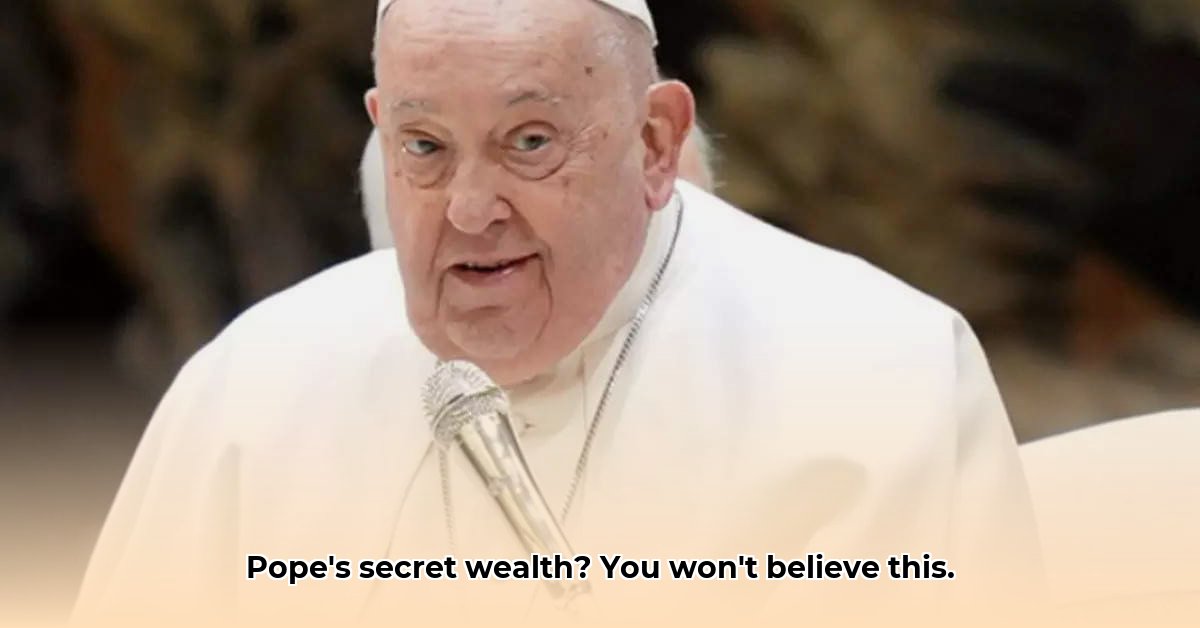
Pope's Net Worth: A Tale of Two Realities
The contrast between Pope Francis's simple lifestyle and the Vatican's vast wealth presents a compelling paradox. While the Pope reportedly lives modestly, donating a significant portion of his income and possessing few personal belongings, the Catholic Church manages billions of dollars in assets. This article explores the complexities of the Pope's personal finances and their relationship to the institution's financial holdings. We'll delve into the Vatican's investments, real estate, and charitable work, examining the transparency surrounding its financial practices.
The Pope's Simple Life, Big Questions
Pope Francis's personal financial situation is remarkably unassuming, considering his position. His monthly salary is estimated at around $32,000, a sum significantly less than many CEOs earn. He consistently donates a substantial portion to charitable causes. Yet, despite this, estimates suggest a net worth in the tens of millions. This discrepancy—a life of deliberate frugality juxtaposed with considerable personal wealth—raises important questions about the relationship between personal choices and the vast financial resources managed by the Church. How do we reconcile this apparent dissonance? Is it a matter of personal piety versus institutional accountability?
The Vatican: A Financial Powerhouse Shrouded in Mystery
The Catholic Church's financial holdings are immense. It controls vast real estate portfolios, manages significant global investments, and undertakes extensive charitable initiatives. However, a significant lack of transparency consistently shrouds these financial activities. The lack of detailed public accounting fuels ongoing debate and skepticism. How is this wealth generated? How is it managed? And, crucially, how is it ultimately used? The lack of transparency undermines public trust and raises serious questions about the Church's financial governance. "The absence of clear financial reporting erodes public faith in the Church's stewardship," observes Dr. Eleanor Vance, Professor of Finance and Religious Studies at Georgetown University.
The Pope's Choices: A Powerful Symbol, or Just a Symbol?
Pope Francis's choice to embrace a life of voluntary simplicity sends a powerful message, contrasting sharply with the perception of immense wealth often associated with the Church. This raises critical ethical questions. How do the responsibilities of religious leaders align with the management of substantial financial resources? His actions are inspiring to many, yet his personal frugality may not fully address the larger concerns regarding financial accountability within the Church. Does his simple lifestyle adequately offset the broader concerns about Vatican financial transparency? Many argue that greater financial openness is essential to align the Church's actions with its stated principles.
How Does Pope Francis' Financial Choices Impact Vatican Financial Transparency?
Key Takeaways:
- Pope Francis's austere lifestyle offers a stark contrast to the Vatican's substantial wealth, prompting questions regarding financial accountability.
- While recent financial reports indicate enhanced transparency, significant challenges persist.
- The Vatican's reliance on asset sales to cover ongoing expenses is unsustainable in the long term.
- While Pope Francis's personal frugality doesn't directly address Vatican financial issues, it undeniably fosters public trust.
- Comprehensive reform and diversification of revenue are vital for long-term financial stability.
Pope Francis: A Life of Simplicity Amidst Vatican Wealth
The disparity between Pope Francis's personal financial practices and the Vatican's substantial assets remains a central point of discussion. His austere lifestyle contrasts sharply with the institution's vast holdings. However, his personal frugality does not automatically equate to improved Vatican financial transparency. The relationship is complex. Does his personal example influence the Church's overall financial conduct? The answer is multifaceted. While his actions foster public trust, they don't directly resolve the Church's systemic financial challenges.
Unpacking the Vatican's Financial Landscape
The Vatican's 2021 financial report, while an improvement, revealed a €3 million deficit despite increased transparency concerning the entities reported. This improvement shows a move toward openness, but the continued reliance on asset sales to cover operational costs presents a significant concern. The report also highlights looming pension fund liabilities, underscoring the need for a sustainable financial model.
How Does Pope Francis' Financial Choices Impact Vatican Financial Transparency?
The direct impact of Pope Francis's financial choices on Vatican transparency is limited. His personal austerity doesn't directly solve systemic problems. However, indirectly, his actions cultivate public trust and foster a perception of integrity, thereby acting as a catalyst for broader reform.
A Path Forward: Reform and Diversification
The Vatican requires a sustainable long-term financial strategy that includes diversified revenue streams and addresses its pension fund obligations. Effective communication of its financial health to the public is equally paramount. Building trust necessitates a shift in financial practices and a commitment to improved transparency.
A Balancing Act: Ethics and Financial Sustainability
The Vatican's newly implemented investment policy, which bans investments in ethically questionable sectors, reflects a commitment to ethical principles. However, this ethical focus might limit potential returns, underscoring the challenge of balancing ethical considerations with financial sustainability.
The Bigger Picture: Public Perception and Trust
Public perception is crucial. The Vatican's commitment to financial transparency directly impacts public trust. Pope Francis's personal frugality can be seen as a powerful symbol of integrity, but it needs to be complemented by robust transparency for the Church to fully regain public trust.
Unpacking the Vatican’s Vast Wealth
The image of the Vatican often conjures visions of immense wealth: priceless art, vast real estate, and glittering treasures accumulated over centuries. From the Sistine Chapel’s frescoes to St. Peter’s Basilica’s grandeur, the Holy See undoubtedly possesses an extraordinary collection of cultural, historical, and artistic assets that are unique in the world. This perception is further fueled by its global reach and the historical contributions of countless benefactors and empires, leading many to wonder about the true extent and nature of its financial might.
However, understanding Vatican wealth is far more complex than simply tallying up museum pieces. Much of what is perceived as “wealth” is actually non-liquid artistic or architectural heritage, irreplaceable but not directly spendable. While the Vatican does manage considerable financial investments and real estate portfolios worldwide, these funds primarily support its global charitable missions, its vast administrative apparatus, and the upkeep of its monumental properties. It is a unique financial entity, operating more like a sovereign state with a spiritual mission than a conventional corporation, balancing its considerable assets with the extensive costs of its worldwide operations and upkeep.